The LogProduct
Nowcast vs Forecast: What Sets Them Apart
Discover the key differences between nowcasting and forecasting, and learn how each approach impacts decision-making in various fields.

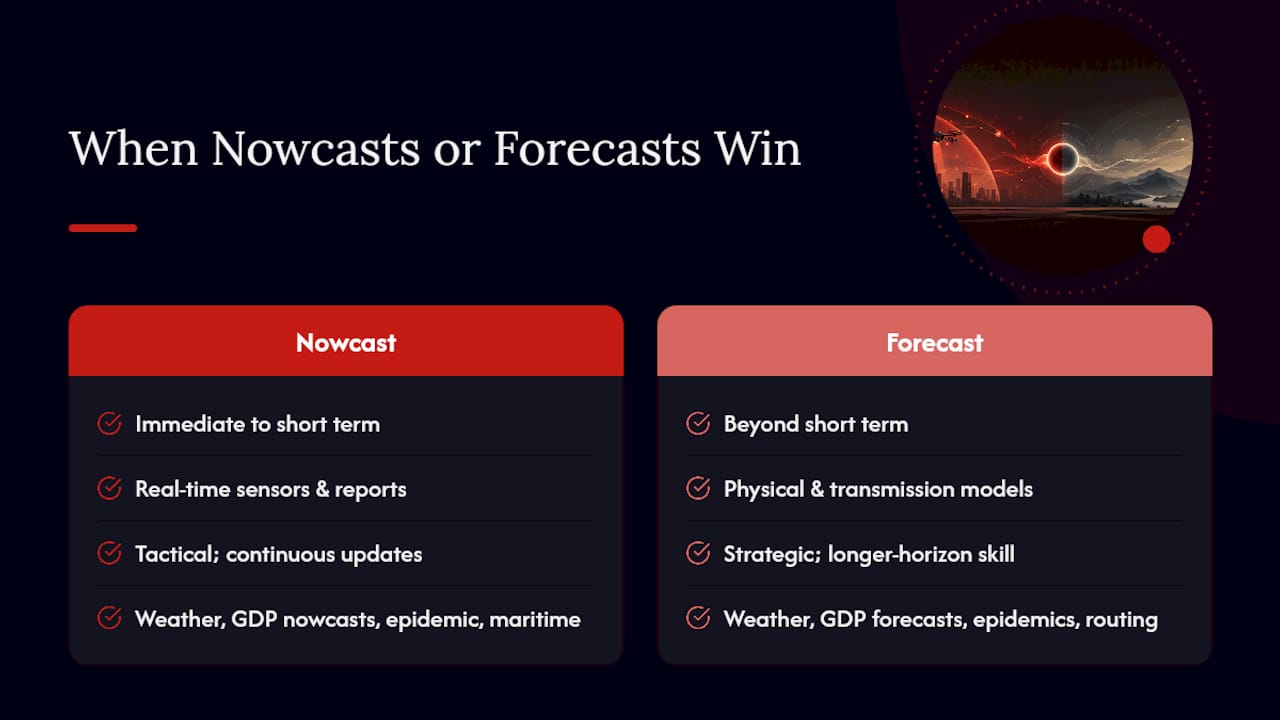
A nowcast estimates the present or the very near future using high-frequency observations. A forecast projects further out using historical patterns, models, and scenario assumptions. That’s the whole distinction in one sentence, but it plays out differently depending on where you’re standing.
A meteorologist watching radar tells you rain will hit your marina in 40 minutes. That’s a nowcast. A climate model telling you next winter will likely bring more storms than average to your coastline. That’s a forecast. In economics, a central bank estimating this quarter’s GDP growth from retail sales and freight data before the official number exists is nowcasting. A bank projecting GDP growth for next year is forecasting.
Three things separate the two approaches every time:
- Time horizon. Nowcasts cover minutes to a few weeks; forecasts stretch from days to years.
- Data cadence. Nowcasts lean on high-frequency, often incomplete data arriving in real time; forecasts can wait for cleaner, complete datasets.
- Decision use. Nowcasts drive immediate, tactical choices; forecasts inform strategic planning and resource allocation.
Key Takeaways
Nowcasting estimates the present using high-frequency data while forecasting projects the future using historical patterns, and combining both approaches consistently outperforms relying on either alone.
| Point | Details |
|---|---|
| Core distinction | Nowcasts estimate the present or very near future; forecasts project further out using models and history. |
| Data latency drives the choice | Nowcasting exists because official or complete data often lag the moment decisions need to happen. |
| Methods differ by horizon | DFM and Kalman filters dominate nowcasting; NWP, ARIMA, and VAR dominate longer forecasts. |
| Hybrid approaches reduce error | Combining nowcasting with other methods cut short-range error by a substantial margin in one comparative review. |
| Maritime decisions need both | Forecasts shape the passage plan; real-time nowcasts confirm whether that plan still holds. |
Further reading and primary sources follow below.
Table of Contents
- Nowcast vs Forecast: Defining the Terms Precisely
- How Do Nowcasts and Forecasts Actually Compare?
- What Methods Power Each Approach?
- Where Each Approach Wins in Practice
- How Much Does Accuracy Really Drop With Horizon?
- When Should You Use a Nowcast Instead of a Forecast?
- A Maritime Example: Nowcasts and Forecasts on the Same Passage
- What Comes Next for Nowcasting and Forecasting?
- Where to Read More on Nowcasting and Forecasting Methods
- Frequently Asked Questions
- Sources
Nowcast vs Forecast: Defining the Terms Precisely
Nowcasting means predicting the very recent past, the present, and the very near future, typically minutes to a few hours in weather, or the current quarter in economics. The term migrated from meteorology into economics, where Giannone and colleagues formalized it in 2008 as a framework for tracking GDP in real time using a stream of partial, staggered data releases. Before their work, economists had no rigorous way to talk about “what’s happening right now” when official statistics lagged by months.
Forecasting, by contrast, means projecting future states over longer horizons, days to years, using historical patterns, causal models, or scenario assumptions. The term is older and more familiar: weather forecasts for next week, revenue forecasts for next fiscal year, epidemic forecasts for the coming flu season.
The World Meteorological Organization treats nowcasting as its own discipline within short-range prediction, distinct from the numerical weather prediction that dominates longer horizons. This isn’t a semantic quirk. Meteorological agencies staff separate teams and run separate systems for nowcasting and forecasting because the underlying math, data, and skill requirements diverge sharply past a few hours. Economists borrowed both the concept and, later, much of the terminology, and the parallel survey work by Stock and Watson helped cement nowcasting as a distinct econometric practice rather than just “forecasting with less data.”
How Do Nowcasts and Forecasts Actually Compare?
| Dimension | Nowcast | Forecast |
|---|---|---|
| Typical time horizon | Minutes to a few weeks (often a few hours in weather, current quarter in economics) | Days to years ahead |
| Objective | Estimate the present or very recent state | Predict a future state |
| Data latency & frequency | High-frequency, often incomplete or asynchronous | Lower-frequency, more complete by publication time |
| Update cadence | Continuous or daily, revised as new data arrive | Periodic (weekly, monthly, quarterly, seasonal) |
| Common methods/models | DFM, Kalman filter, extrapolation, high-frequency alternative data | NWP, ARIMA, VAR, scenario models, longer-horizon ML |
| Typical applications | GDP tracking, storm warnings, outbreak surveillance, tactical routing | Budget planning, seasonal forecasts, epidemic projections, voyage strategy |
| Accuracy vs. horizon | High near-term skill, degrades fast beyond its window | Skill declines gradually but holds over a wider range |
The most consequential difference on this table isn’t methodology. It’s data latency. Official GDP figures often arrive with a lag of a month or more after the quarter ends, and by the time analysts have a full clean dataset, the economic moment has already passed. Weather stations, satellites, and shipping sensors update by the minute. That timing gap is the entire reason nowcasting exists as a separate practice rather than just “forecasting done faster.”
In practice, few organizations pick one approach and stick with it. Weather services blend nowcasting output with high-resolution numerical models to smooth the handoff as the nowcast’s skill fades and the forecast’s skill takes over, a transition meteoblue describes as central to modern operational forecasting. Central banks do something similar, updating a nowcast daily while running a separate long-range forecast for policy decisions that won’t take effect for months.
What Methods Power Each Approach?
Nowcasting techniques are built to squeeze signal out of incomplete, mismatched data:
- Dynamic factor models (DFM) extract a small number of common signals from dozens or hundreds of noisy indicators, letting analysts summarize an entire economy in a handful of latent factors.
- Kalman filter and state-space methods update the model’s estimate of the current state each time new data arrives, even when some series are missing entirely, which is what makes them the foundational architecture for nowcasting systems worldwide.
- Mixed-frequency approaches (MIDAS and related techniques) let monthly, weekly, and daily data feed into a single model without forcing everything onto the same calendar.
- High-frequency alternative data, credit card transactions, shipping manifests, mobility signals, fills gaps between official releases.
- Radar and satellite extrapolation tracks storm cells and precipitation fields forward a few hours, the backbone of weather nowcasting.
- Machine-learning augmentations now sit alongside DFMs in some pipelines, and an IMF working paper shows how combining DFMs, ML, and novel data sources scales GDP nowcasting across dozens of countries at once.
Forecasting methods, meanwhile, tend to trade real-time responsiveness for structural or statistical depth. Numerical weather prediction (NWP) solves physical equations of atmospheric motion on supercomputers, projecting days ahead rather than hours. Classical time-series models like ARIMA and VAR capture patterns in historical data to project economic indicators forward. Scenario-based forecasting builds multiple plausible futures (recession, baseline, boom) rather than a single point estimate. Longer-horizon machine-learning models, from gradient boosting to neural networks, increasingly handle multi-month projections where classical statistical assumptions break down.
The technical headache both camps share is the ragged edge, the awkward reality that data series in a real-time dataset arrive at different frequencies and with different publication lags. One series updates daily, another monthly, a third gets revised twice after initial release. A technical note on factor and MIDAS approaches walks through why state-space models handle this better than simpler regression approaches: they can infer the latent current state even when half the inputs for this week haven’t posted yet.
Where Each Approach Wins in Practice
Economics offers the clearest case for nowcasting’s existence. Official GDP figures lag the quarter they describe, sometimes by six weeks or more, which leaves policymakers flying blind if they wait for the clean number. Institutions solve this by blending soft data (surveys, sentiment indexes) with hard data (industrial production, retail sales) as the quarter progresses. Early in the window, soft data dominate because it’s all that’s available; hard data take over as they post. The New York Fed’s Staff Nowcast is the best-known public example, updated weekly and shown to match institutional forecast accuracy for short horizons while offering continuous updates a quarterly forecast simply cannot.
Meteorology draws the sharpest line between the two disciplines. Nowcasting, built on radar, satellite, and lightning detection, dominates the zero-to-few-hour window because extrapolating a storm cell’s current trajectory works well when conditions aren’t changing fast. Push past that window and atmospheric chaos makes extrapolation unreliable. That’s exactly where NWP takes over, solving physical equations rather than tracking existing patterns forward.
Epidemiology runs a parallel story. Case counts reported today usually undercount the true infection rate because of reporting delays, so epidemiologists nowcast the “true” current incidence from partial, delayed case reports. Longer epidemic forecasts, projecting where a wave heads over the next month, rely on separate transmission models layered on top of that corrected present-state estimate.
Maritime operations blend both approaches constantly, often without naming them as such. Real-time observations, currents, wind gusts, AIS vessel positions, tide gauges, feed tactical nowcasts that tell a skipper what’s happening in the next hour. Longer-range routing models and seasonal wind patterns support the forecast-driven strategic plan for the whole passage. Neither replaces the other; a passage plan built purely on forecasts ignores a squall line forming ten miles out, and a plan built purely on nowcasts has no sense of where the boat should be tomorrow.
How Much Does Accuracy Really Drop With Horizon?
Choosing the right metric matters before comparing any numbers. Mean absolute error (MAE) and root mean squared error (RMSE) work well for point estimates like temperature or GDP growth. Mean absolute percentage error (MAPE) normalizes for scale, useful when comparing errors across countries or variables of different magnitudes. Probabilistic scoring, like the Brier score or continuous ranked probability score, matters more when a forecast is a probability distribution rather than a single number, which is increasingly how weather and epidemic forecasts get communicated.
Combining nowcasting methods with other approaches tends to cut short-range error meaningfully. One review of forecasting methods found that combining diverse methods or applying nowcasting has reduced average short-range error by a substantial margin compared to relying on a single traditional forecast alone. That’s a meaningful gap for anyone deciding whether a single model is good enough.
The underlying reason accuracy improves as more intra-period data arrive is intuitive once you see it: each new data point narrows the range of plausible current states, the same way a jigsaw puzzle gets easier to solve as more pieces go in. This is also why hybrid approaches beat single methods so consistently. A DFM catches broad co-movements across dozens of series; a Kalman filter updates that estimate as fresh data lands; an ML layer can catch nonlinear relationships neither one sees alone. Stacked together, they outperform any single method run in isolation, particularly in the messy first stretch of a data window when the ragged edge is at its worst.
When Should You Use a Nowcast Instead of a Forecast?
Four questions settle most nowcast-versus-forecast decisions:
- What’s your required lead time? If you need an answer in the next hour or need to know what’s happening right now, you need a nowcast. If you’re planning a budget, a season, or a voyage weeks out, you need a forecast.
- How fast and complete is your data? Nowcasting only works if you have high-frequency inputs, even imperfect ones. Without that, you’re just forecasting with a shorter label.
- Can you tolerate revisions? Nowcasts get revised constantly as new data lands. If your process can’t absorb a changing estimate, build in a review cadence rather than treating the first number as final.
- What does a false signal cost you? A false nowcast alert that triggers a minor operational change is cheap. A false nowcast that triggers an evacuation or a route change into worse conditions is expensive. Weigh that cost against the cost of waiting for a more stable, if slower, forecast.
Here’s a short implementation checklist for teams building either capability:
- Inventory every data source by frequency, lag, and reliability before choosing a model.
- Build an explicit plan for the ragged edge, whether that’s a Kalman filter, imputation, or a simpler bridge equation.
- Pick models suited to your horizon, DFM or Kalman-based approaches for nowcasts, NWP or time-series models for forecasts.
- Set an update cadence that matches how fast your underlying data actually changes, not an arbitrary schedule.
- Build a validation plan that tracks error by horizon, not just an aggregate score.
- Decide in advance how you’ll communicate revisions to whoever acts on the output.
Pro Tip: Don’t build your entire nowcast around one high-frequency signal just because it’s the most exciting one available. A single alternative dataset, shipping traffic or credit card spend, can drift or break silently, and a model with no redundancy has no way to notice.
A Maritime Example: Nowcasts and Forecasts on the Same Passage
Picture a coastal passage where the tide window closes in four hours, a wind squall is building offshore, and the current through a narrow channel has been shifting faster than the tide tables predicted. A forecast set this trip’s strategic shape days ago: departure time, expected wind direction, rough passage duration. None of that accounts for what’s happening on the water right now.
This is where nowcasting earns its keep. Real-time marine feeds, live wind observations, current data, tide predictions, updated harbor conditions, tell you whether the plan built on Tuesday’s forecast still holds on Thursday morning. Nausika’s connector feeds exactly this kind of real-time, validated marine data directly into the AI assistants sailors already use, so the tactical picture (what’s happening in the next hour) stays grounded in verified sources rather than a stale forecast or a plausible-sounding guess. The workflow that actually works isn’t nowcast or forecast. It’s forecast for the shape of the plan, nowcast for the moment you commit to executing it. Real, validated maritime data closes the gap between the two instead of forcing a sailor to choose.
Pro Tip: When a nowcast update changes the tactical picture, tell your watch team what changed and why, not just the new number. “Wind’s backing 15 degrees earlier than forecast” gives someone at the helm far more to work with than a silently updated readout.
What Comes Next for Nowcasting and Forecasting?
The gap between nowcasting and forecasting is going to keep narrowing, not because forecasting is getting worse, but because data pipelines are getting faster and cheaper to build. Ten years ago, blending shipping manifests, satellite imagery, and survey data into one model was a research project. Now it’s closer to a standard architecture, and the IMF’s own work on scalable DFM-plus-ML frameworks shows how quickly that capability is spreading beyond the handful of institutions that pioneered it.
The risk I’d flag is overconfidence in the continuous update itself. A nowcast that refreshes every hour feels more authoritative than a forecast that updates once a month, simply because it moves more. That’s a psychological trap, not a statistical one. A frequently updated estimate built on noisy, incomplete data isn’t automatically better than a stable forecast built on cleaner information; it’s just more responsive. Organizations that treat every nowcast tick as new truth, rather than as a probabilistic best guess given today’s partial evidence, end up whipsawing their own decisions.
The practical move is to build feedback loops that track your own model’s error by horizon over time, not just once at launch, and to keep testing whether a hybrid pipeline actually beats your simpler baseline before you commit to the added complexity. Interpretability matters here too. A Kalman filter you can explain to a decision-maker in one sentence is often more useful operationally than a marginally more accurate black-box model nobody trusts enough to act on quickly.
Where to Read More on Nowcasting and Forecasting Methods
- Lessons from Nowcasting GDP across the World, a detailed technical resource on DFM and Kalman filter architecture for economic nowcasting, best suited for readers building or evaluating a model.
- Forecasting and Nowcasting Macroeconomic Variables, a working paper covering the New York Fed’s operational nowcast approach, useful as a real-world implementation reference.
- WMO OSCAR guidance on nowcasting and very short-range forecasting, the clearest conceptual survey of where nowcasting ends and NWP forecasting begins in meteorology.
- Nowcasting GDP: A Scalable Approach (IMF Working Paper), a practical guide to combining DFM, machine learning, and alternative data at scale.
- Nowcasting vs Forecasting: Where Real-Time Data Matters Most, an accessible explainer on how operational weather services blend the two approaches day to day.
Frequently Asked Questions
What does nowcast mean, exactly? A nowcast is an estimate of the present, the very recent past, or the very near future, built from high-frequency data rather than long-term historical patterns. In weather, that typically means the next two to six hours. In economics, it usually means the current quarter, before official statistics are published.
What is the main difference between nowcast and forecast? The main difference is time horizon and data source. A nowcast uses real-time, high-frequency data to estimate what’s happening right now, while a forecast uses historical patterns and models to project further into the future, days, months, or years ahead.
When should you use nowcasting instead of forecasting? Use nowcasting when you need to know the current state of a fast-moving system, storm conditions in the next hour, this quarter’s GDP growth, or today’s true infection rate, and when high-frequency data is available to support it. Use forecasting for longer-range planning where historical patterns and structural models are more reliable than incomplete real-time signals.
Why do nowcasts get revised so often? Nowcasts are built on incomplete data that arrives on a rolling basis. As new information posts, whether it’s a delayed economic release or updated radar imagery, the model updates its estimate of the current state. That’s a feature of the method, not a flaw.
Can nowcasting and forecasting be combined? Yes, and in most mature systems they already are. Weather services blend nowcasting with numerical weather prediction to smooth the transition from hours to days, and economic institutions run a continuously updated nowcast alongside a separate longer-range forecast for policy planning.
Sources
- Lessons from Nowcasting GDP across the World
- Forecasting and Nowcasting Macroeconomic Variables
- 2.3 Nowcasting / Very Short-Range Forecasting - WMO OSCAR
- Nowcasting GDP: A Scalable Approach Using DFM, Machine Learning and Novel Data (IMF WP)
- Nowcasting vs Forecasting: Where Real-Time Data Matters Most - meteoblue