The LogProduct
Rule of Twelfths for Sailors: Quick 6 Hour Estimate, Check Nausika
Estimate hour-by-hour tide height with the Rule of Twelfths (1:2:3:3:2:1) and six hour timing. See a worked example, minute adjustments, then verify with...
The Rule of Twelfths estimates how much a tide rises or falls hour by hour by splitting the total range into twelfths using a 1:2:3:3:2:1 pattern. Sailors, surfers, and kayakers use it to get a rough depth or timing estimate between known high and low water. It’s a mental shortcut, not a substitute for official tide tables when the decision actually matters.
TL;DR:
- The Rule of Twelfths approximates tidal height changes by assuming a sine wave, with the steepest change occurring in hours three and four.
- Its accuracy depends on high and low water times from official tide tables and can be distorted by wind, pressure, and local estuary conditions.
- For tides that do not span exactly six hours, divide the actual minutes between high and low water by six to adjust the twelfth intervals accordingly.
- Nausika enhances the rule by providing real-time, validated tide predictions and local conditions, helping to verify or adjust mental estimates before critical decisions.
- Relying solely on the rule without considering local factors or official data can lead to significant misjudgments, especially near river mouths and enclosed harbors.
Table of Contents
- How the Rule of Twelfths Works: Dividing the Tidal Range
- Worked Example: Calculating Tide Height Step by Step
- Practical Uses: Launching, Crossing, and Anchoring
- Where the Rule of Twelfths Breaks Down
- Adjusting the Rule When the Tide Cycle Isn’t Six Hours
- How Nausika Complements the Twelfths Method
- What the Rule of Twelfths Gets Right, and Where Sailors Push It Too Far
- Get Validated Tide Data Alongside Your Quick Estimate
- Sources
How the Rule of Twelfths Works: Dividing the Tidal Range
Start with the tidal range, the difference between the high water height and the low water height. Divide that number by 12, and you get the value of one twelfth. That single number becomes the building block for everything else.
The rule then spreads those twelve parts across the roughly six hours it typically takes for water to move from low to high (or the reverse on the ebb). Instead of assuming the water rises at a steady rate, the Rule of Twelfths allocates the twelfths unevenly, because tides don’t move like a filling bathtub. They move like a sine wave, slow at the turning points and fast in the middle.
Here’s the allocation, hour by hour, moving from low water to high water:
- Hour 1: 1 twelfth
- Hour 2: 2 twelfths
- Hour 3: 3 twelfths
- Hour 4: 3 twelfths
- Hour 5: 2 twelfths
- Hour 6: 1 twelfth
On the ebb, the same pattern runs in reverse, fast in the middle, slow at both ends. The intuition is straightforward once you picture a sine curve: near high or low water, the curve flattens out, so the water barely moves. Near the midpoint, the curve is steepest, so hours three and four each account for a quarter of the entire range. That’s why a boat that looked safely afloat two hours after low tide can be aground twenty minutes later. The middle of the cycle is where depth changes fastest, and it’s the part sailors most often underestimate.
Worked Example: Calculating Tide Height Step by Step
Numbers make this concrete. Say low water is 1.2 meters and high water is 6.0 meters, six hours later. Here’s how the twelfths method turns that into an hour-by-hour depth estimate.
- Find the range. 6.0m minus 1.2m equals 4.8m.
- Find one twelfth. 4.8m divided by 12 equals 0.4m per twelfth.
- Allocate by hour. Hour 1 adds 1 twelfth (0.4m), hour 2 adds 2 twelfths (0.8m), hour 3 adds 3 twelfths (1.2m), hour 4 adds 3 twelfths (1.2m), hour 5 adds 2 twelfths (0.8m), hour 6 adds 1 twelfth (0.4m).
- Run the cumulative total. After hour 1: 1.6m. After hour 2: 2.4m. After hour 3: 3.6m. After hour 4: 4.8m. After hour 5: 5.6m. After hour 6: 6.0m, matching the known high water.
Pro Tip: Each twelfth in this example is worth 0.4m, so four hours after low water the tide has already climbed 4.8m, exactly three-quarters of the total range.
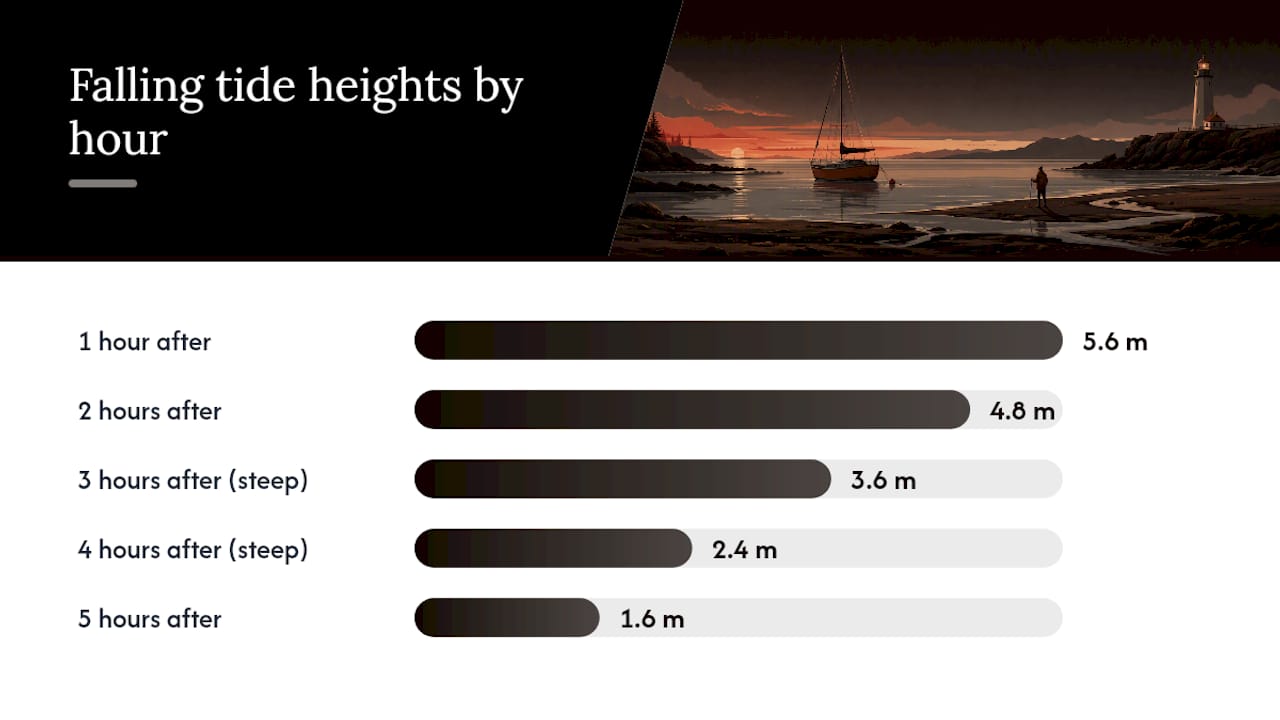
Run it backward for a falling tide and the logic holds. If high water is 6.0m and low water is 1.2m six hours later, the same 0.4m twelfth value applies, but you subtract instead of add: 5.6m, 4.8m, 3.6m, 2.4m, 1.6m, 1.2m. The steepest drop still lands in hours three and four, which is exactly when a mooring that looked comfortable at high water can suddenly feel tight.
Practical Uses: Launching, Crossing, and Anchoring
The rule earns its keep in specific, time-pressured moments on the water. A few common cases where sailors reach for it:
- Slipway launches. Estimating whether there’s enough water over the ramp right now, not in twenty minutes.
- Causeway and tidal crossing timing. Deciding whether a sandbar or causeway will be passable before the window closes.
- Mooring and swing-room checks. Confirming a boat won’t touch bottom at low water given its draft.
- Surf and kayak spot planning. Judging whether a reef break or put-in point will have enough depth at a given hour.
All of it depends on one thing: accurate high and low water times and heights for the day, pulled from a real tide table rather than memory or a guess. Once you have those, estimating the time offset for “right now” is just subtracting your current time from the last low or high water.
Because the rule is an approximation of a sine curve rather than the tide itself, cruising guides recommend building in a conservative buffer rather than treating the estimate as exact. Adding even 15 to 20 minutes of margin, or treating a marginal depth reading as insufficient, costs nothing and can save a hull.
Where the Rule of Twelfths Breaks Down
The rule assumes a clean, symmetrical sine curve between two tide points six hours apart. Real coastlines rarely cooperate. Several factors can throw the estimate off by a meaningful margin.
- Wind setup. A sustained onshore blow can pile up water well above the predicted height.
- Barometric pressure. Low pressure systems raise sea level; high pressure suppresses it.
- River flow and estuaries. Freshwater discharge can delay or advance the tide and distort the curve shape entirely.
- Diurnal inequality and double tides. Some coastlines get two unequal highs and lows a day, or only one, which breaks the six-hour assumption outright.
Maritime writers who cover tide prediction are blunt about this: the rule is a mental shortcut for on-the-go planning, not a stand-in for local knowledge. In an estuary with strong outflow, local setup can shift apparent high water by tens of minutes and change levels by a real fraction of the total range, enough to turn a “safe” mooring calculation into a grounding.
A quick heuristic tells you roughly where the tide should be. It can’t tell you what the wind did overnight, what the river is carrying, or whether your harbor has a double high water. Treat the number as a starting point, not a verdict.
Where a decision actually carries risk, whether that’s clearing a bar, sailing under a low bridge, or leaving a boat on a drying mooring, cross-check the estimate against official tide tables and a local tidal curve before committing.
Adjusting the Rule When the Tide Cycle Isn’t Six Hours
Not every tide runs exactly six hours from low to high. When it doesn’t, the fix is simple arithmetic: take the actual number of minutes between low and high water and divide by six. That gives you minutes per twelfth instead of assuming a flat 60.
Say low water is at 08:00 and high water is at 14:12, a gap of 6 hours 12 minutes, or 372 minutes. Divide 372 by 6 and each twelfth block covers 62 minutes rather than 60. Apply the same 1:2:3:3:2:1 heights, just spaced 62 minutes apart instead of 60.
When the math doesn’t divide evenly, round the twelfth length up rather than down. A slightly longer twelfth underestimates how far the tide has moved by a given clock time, which is the safer direction to be wrong in.
On deck, the quick checklist looks like this:
- Note the exact low and high water times from the tide table.
- Subtract to get total minutes, then divide by six.
- Round that number up to the nearest minute.
- Multiply by 1, 2, 3, 3, 2, 1 for each successive block, adjusting your clock reference each time.
How Nausika Complements the Twelfths Method
A heuristic like the Rule of Twelfths is genuinely useful for a fast, on-the-spot check, but it’s built on an approximated curve, not your actual harbor. That’s the gap Nausika is designed to close. Instead of guessing whether a real tide matches the sine-curve assumption, you get real-time tide predictions pulled from validated marine sources, layered with harbor depth data, wind, and pressure overlays that explain exactly the local distortions a mental calculation can’t see.
Nausika doesn’t replace the twelfths method. It gives you something to check it against. Run the quick math in your head for a sense of timing, then compare it to Nausika’s validated forecast before you commit to a launch window, a causeway crossing, or a drying mooring. When the two disagree, that gap is worth investigating before you leave the dock, not after.
What the Rule of Twelfths Gets Right, and Where Sailors Push It Too Far
The Rule of Twelfths deserves its place in every sailor’s head, precisely because it’s the right tool for a narrow job: a fast, rough estimate when you don’t have a tide curve in front of you. Where it goes wrong is when sailors treat a mental shortcut like a measurement. It isn’t one. It’s a sine-curve approximation built for open, semi-diurnal coasts, and it starts drifting the moment wind, pressure, or estuary geometry get involved.
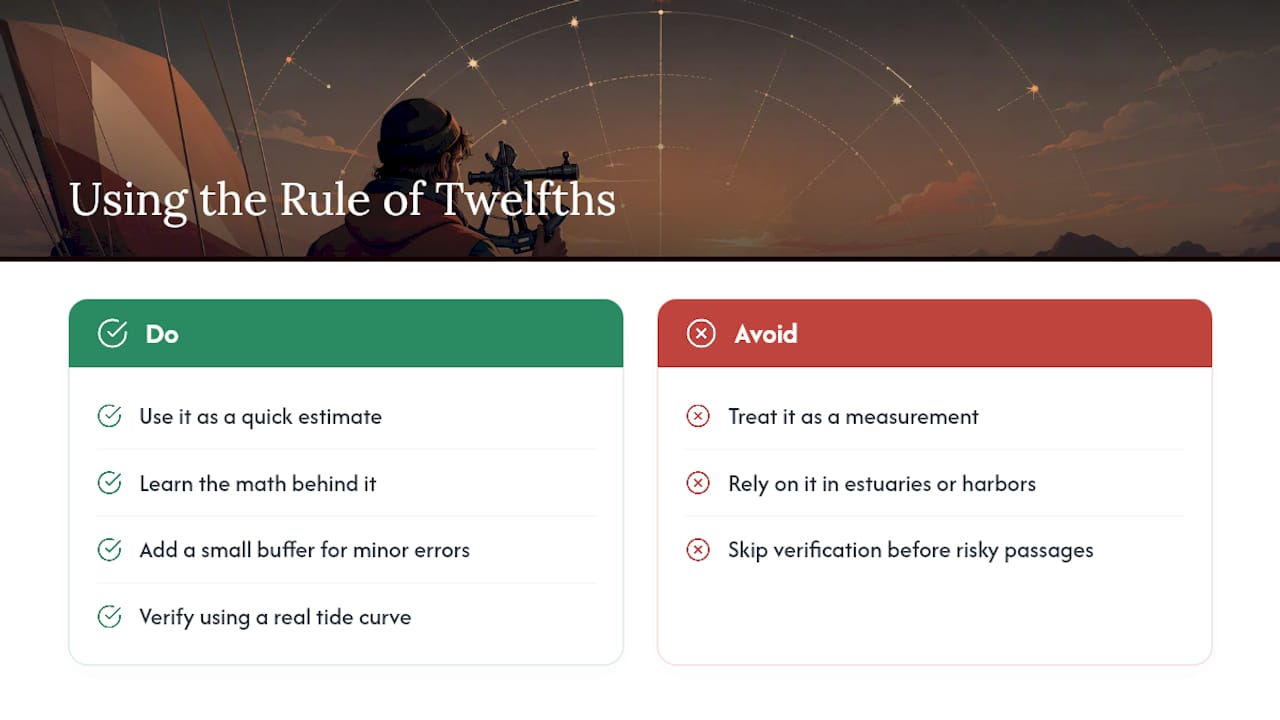
The conventional advice, “just add a buffer,” is fine but incomplete. A buffer protects you from small errors. It does nothing when the actual tidal curve looks nothing like the assumption baked into the rule, which happens more often near river mouths and enclosed harbors than most sailors realize. The better habit is treating the twelfths calculation as a hypothesis, then checking it against a real curve whenever the stakes go up: a shallow entrance, a boat that draws more than you’d like, a mooring you haven’t used before.
Learn the math. Trust it for planning. Verify it before anything that can’t be undone.
— Andrea
Get Validated Tide Data Alongside Your Quick Estimate
Running the twelfths calculation gets you a fast answer. It doesn’t tell you what the wind did last night or whether your harbor has a distorted curve. Nausika closes that gap by feeding your AI assistant real-time, validated tide predictions, harbor depth information, and marine forecasts pulled directly from verified sources, so you’re checking your mental math against real data instead of hoping the sine curve held up.
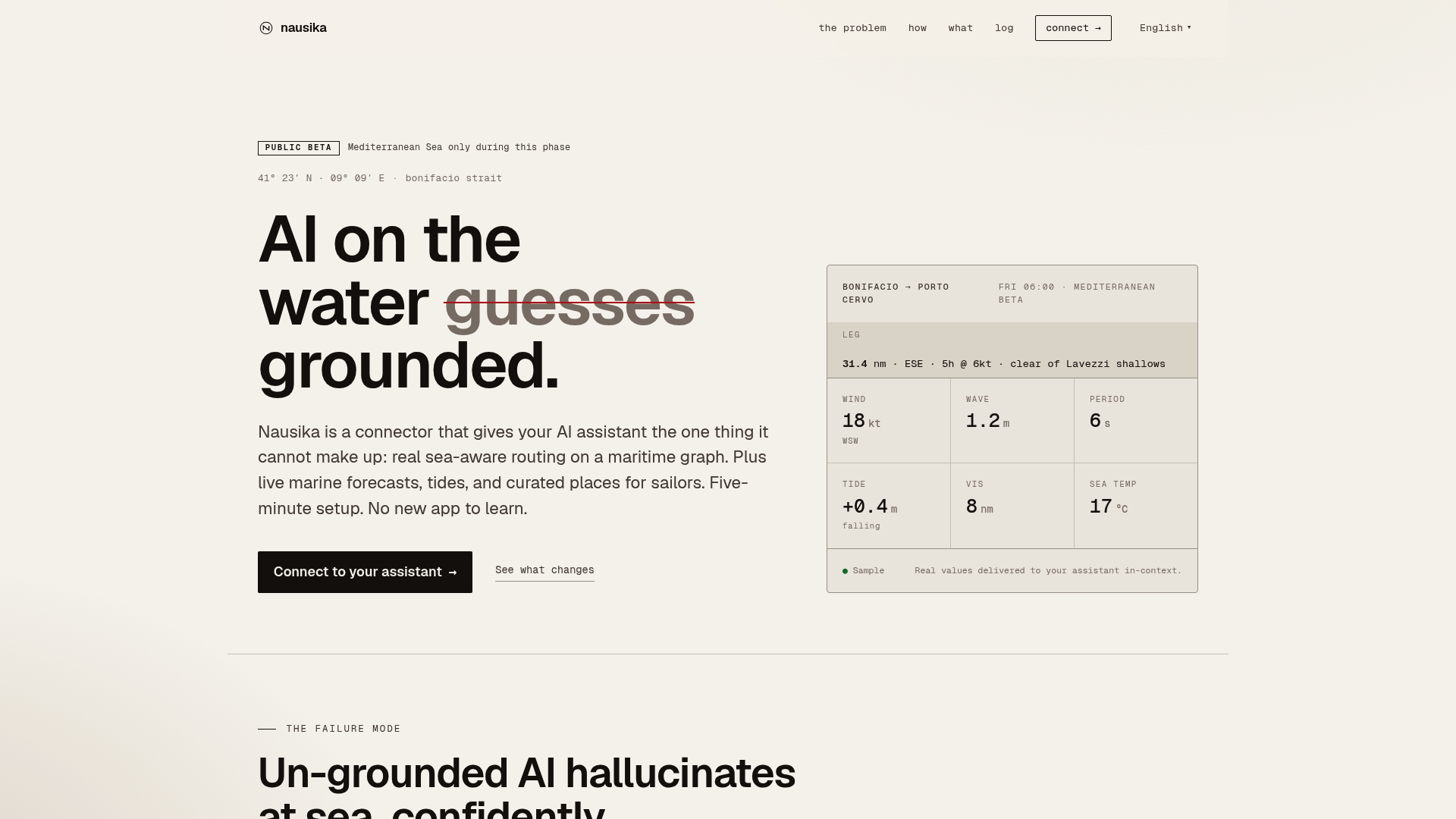
If you’re tired of treating a rule of thumb as your only safety check, connect Nausika to your existing AI assistant and compare its live tide and harbor data against your next twelfths calculation before you leave the dock.
Sources
The Wikipedia entry on the Rule of Twelfths covers the underlying sine-curve math and the minutes-per-twelfth adjustment for non-standard intervals. TideTime.org’s worked guide walks through the 1:2:3:3:2:1 distribution with practical examples. Sail Magazine’s explainer offers a practitioner’s take on the rule’s limits in real coastal conditions. These are references for verification, not endorsements of any single method over checking official tide tables.