The LogProduct
Spring vs Neap Tides: How to Tell and Why It Matters
Discover the differences between spring and neap tides, why they matter, and how their gravitational effects impact ocean levels.
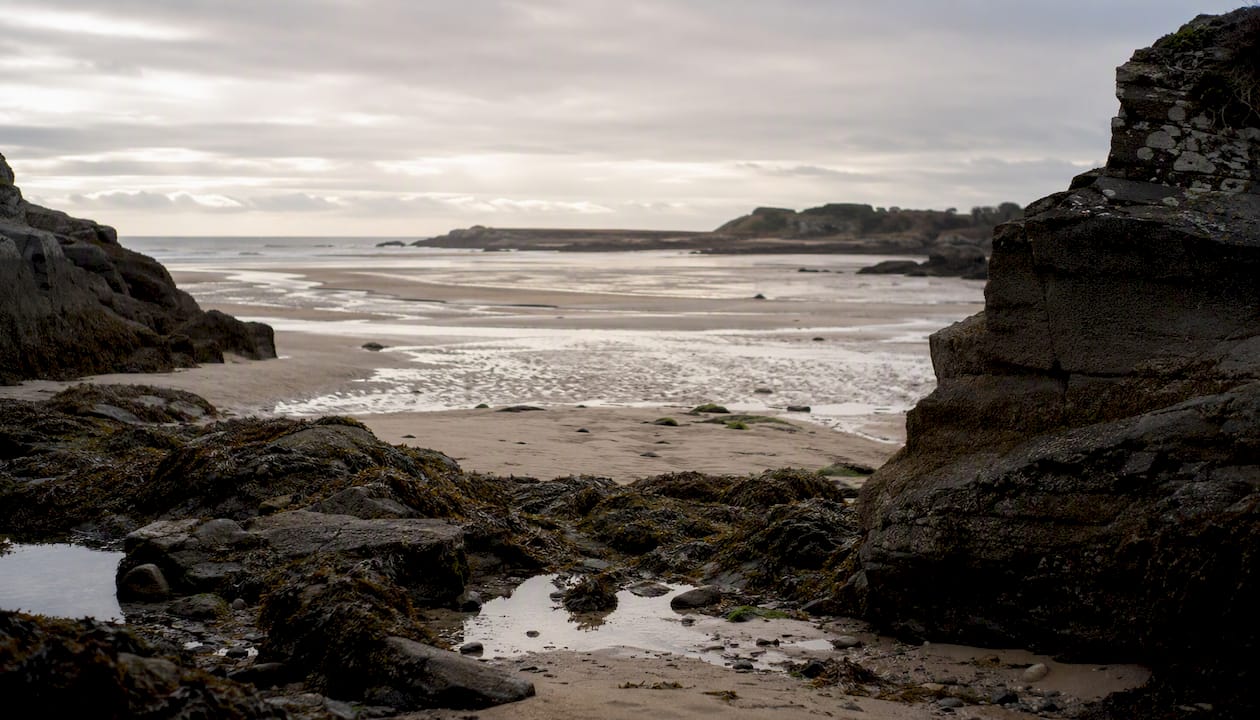
Spring tides produce the month’s largest tidal range, with higher-than-average highs and lower-than-average lows, and occur at every new and full moon. Neap tides produce the smallest tidal range and occur at the first and third quarter moons. The difference comes down to geometry: when the Sun, Moon, and Earth align, their gravitational pulls combine; when the Sun and Moon sit at right angles to Earth, those pulls partially cancel. For exact local timing, NOAA Tides & Currents is your most reliable starting point.
Key Takeaways
Spring tides occur at every new and full moon when solar and lunar forces align; neap tides occur at quarter moons when those forces partially cancel, producing the month’s smallest tidal range.
| Point | Details |
|---|---|
| Spring tides: timing | Occur at new and full moons; produce the month’s highest highs and lowest lows. |
| Neap tides: timing | Occur at first and third quarter moons; produce the month’s smallest tidal range. |
| Physics behind the difference | Solar tidal forces are roughly half the strength of lunar ones; alignment amplifies, quadrature reduces the combined effect. |
| Open-ocean ratio | Equilibrium theory estimates a 2.7:1 spring-to-neap amplitude ratio, heavily modified by local coastal geometry. |
| Practical action | Always use NOAA Tides & Currents for location-specific predictions; lunar phase alone is not sufficient for navigation. |
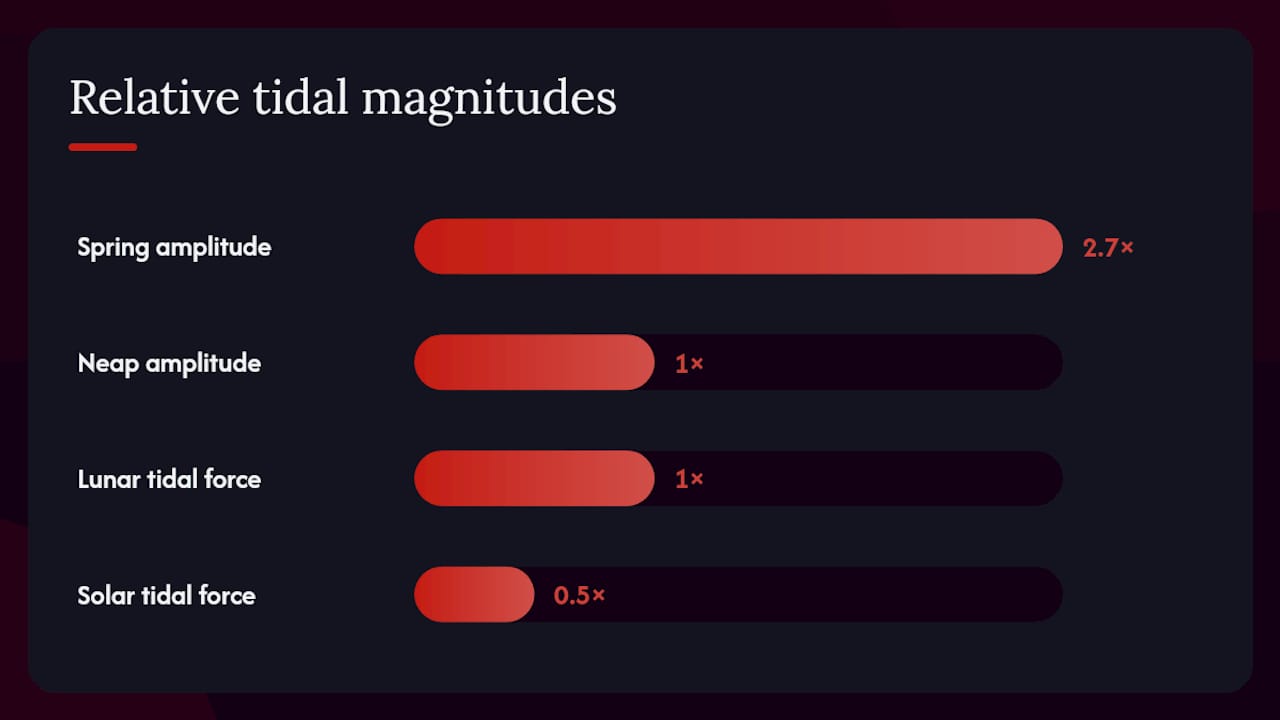
Table of Contents
- Why spring and neap tides happen: the physics of alignment
- When spring and neap tides occur each month
- What spring and neap tides look like at the shoreline
- How to tell whether today is a spring or neap tide
- Why local geography changes everything
- Practical guidance for sailors and coastal planners
- Sources
Why spring and neap tides happen: the physics of alignment
The core driver is gravity, specifically the way the Moon’s gravitational pull and the Sun’s gravitational pull combine or work against each other depending on where each body sits relative to Earth.
The Moon generates the dominant tidal force. Solar tidal forces are roughly half as strong as lunar ones, which means the Sun acts as a continuous modifier of the lunar signal rather than an independent driver. When the two forces align, the result is noticeably stronger tides. When they pull at right angles, the result is noticeably weaker ones.
Two terms describe these geometries precisely:
- Syzygy: Sun, Moon, and Earth in a straight line (or close to it). This happens at new and full moons and produces spring tides.
- Quadrature: Sun and Moon at roughly 90 degrees relative to Earth. This happens at the first and third quarter moons and produces neap tides.
Think of it like two people pulling a rope. If they pull in the same direction, the combined force is strong. If one pulls sideways, the net effect on the rope drops considerably. The ocean responds the same way.
When spring and neap tides occur each month
NASA’s overview of tides confirms the pattern: full and new moons bring spring tides; first and third quarter moons bring neap tides. Each type occurs multiple times per lunar month, and the two types alternate roughly every week.
The lunar cycle runs about a month, so you get multiple distinct tidal events each month, including both spring and neap tides that occur roughly a week apart.
One practical caveat: the peak tidal range at your location rarely coincides exactly with the moment of the lunar phase. Ocean basins have inertia, and the tidal response can lag the lunar phase by up to a day or more in many locations. A full moon at midnight does not guarantee the highest tide at midnight. Always cross-check with a local tide prediction.
What spring and neap tides look like at the shoreline
The most visible difference is tidal range: the vertical distance between high water and low water on a given day.
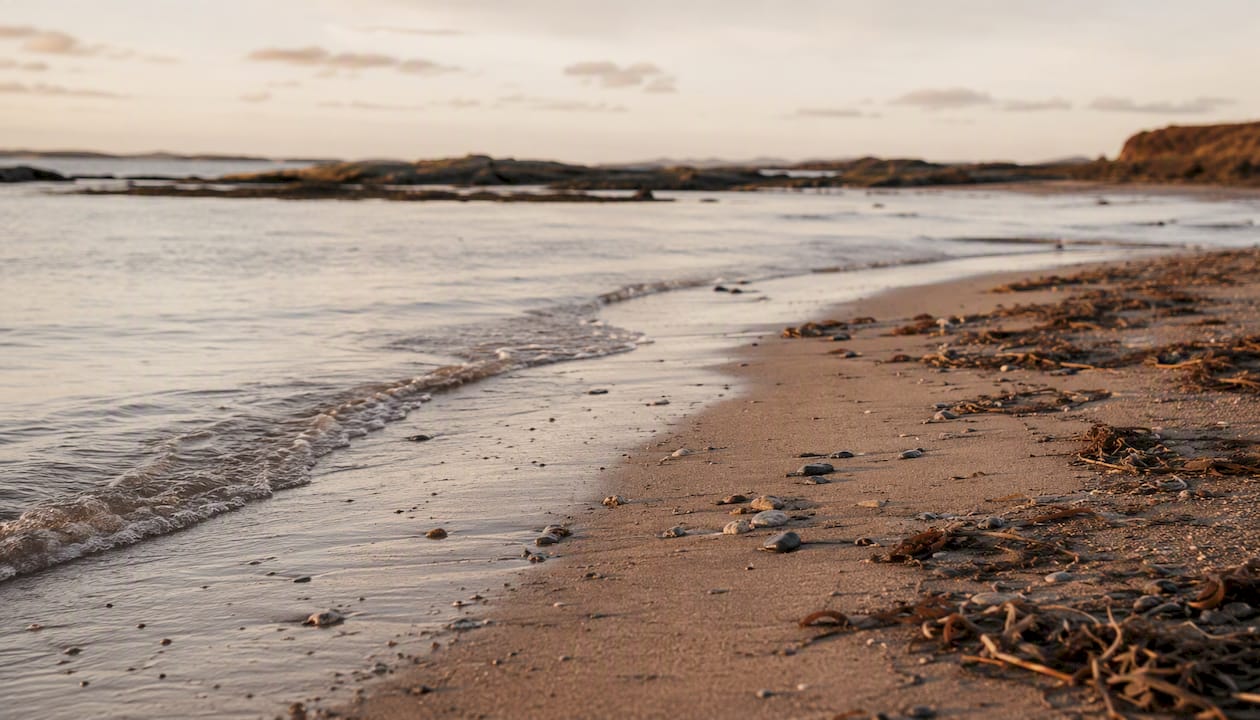
Spring tides push that range to its monthly maximum. High tide climbs higher than usual; low tide drops lower. Currents through inlets and channels run faster. Exposed mudflats and sandbars appear that would stay submerged on an ordinary day.
Neap tides compress the range to its monthly minimum. High water barely rises above the mid-tide mark; low water stays relatively high. Currents slow. The shoreline looks almost static compared to a spring day.
Equilibrium theory estimates the spring-to-neap amplitude ratio at about two to three times in the open ocean/03%3A_Ocean_waves/3.07%3A_Generation_of_the_tide/3.7.4%3A_Spring_and_neap_tide), but treat that number as a conceptual reference, not a local prediction. Coastal geometry, shelf depth, and basin resonance can push real-world ratios far above or below that figure.
A few practical contrasts worth keeping in mind:
- Currents: Spring tides drive stronger tidal currents through constricted passages; neap tides produce gentler flow.
- Navigation margins: A vessel with significant draft needs more caution during spring low tides, when water levels drop furthest.
- “King Tide”: A popular term for an exceptionally high spring tide, often when a spring tide coincides with lunar perigee (the Moon’s closest approach to Earth). These perigean spring tides produce slightly larger ranges than ordinary spring tides and are worth flagging on any passage plan.
How to tell whether today is a spring or neap tide
The quick rule: new or full moon means spring tide; quarter moon means neap tide.
Here is a reliable step-by-step method:
- Check the lunar phase. A moon calendar, weather app, or almanac gives you the current phase in seconds.
- Pull the NOAA tide prediction for your location. NOAA Tides & Currents provides official, station-specific predictions for U.S. waters. Look at the predicted tidal range for the day, not just the high-water time.
- Compare the range to recent days. If today’s range is notably larger than yesterday’s, you are likely approaching or at a spring tide. A shrinking range points toward neap.
- Check recent station observations. NOAA stations publish verified water-level readings alongside predictions. When predictions and observations agree closely, confidence in the forecast is high.
Pro Tip: Never rely on lunar phase alone for navigation decisions. A quarter-moon neap tide at a resonant inlet can still produce strong currents. Use validated, location-specific forecasts every time.
Why local geography changes everything
The lunar-phase rules above describe what happens in an idealized, open ocean. Real coastlines are not ideal.
Local factors that can amplify or suppress the spring/neap contrast include:
- Basin resonance: Some bays have a natural oscillation period close to the tidal period, which amplifies tidal range dramatically. The Bay of Fundy in eastern Canada is the textbook case, with ranges exceeding 50 feet during spring tides.
- Estuary shape: Funnel-shaped estuaries concentrate tidal energy as water moves inland, raising the range.
- Coastal shelf gradient: Shallow, gently sloping shelves allow tidal waves to build; steep drop-offs do not.
- Inlets and channels: Constrictions can accelerate currents without proportionally raising water levels, or vice versa.
- Amphidromic points: Locations in the ocean where the tidal range is nearly zero because tidal waves rotate around them. Near these points, the spring/neap contrast is minimal regardless of lunar phase.
As NASA notes, theoretical equilibrium models do not reliably predict coastal magnitudes. Basin geometry, continental shelves, and depth variations cause significant local distortions that only station-based observations can capture.
Why we call them “spring” and “neap”
“Spring” has nothing to do with the season. The word comes from Old English, where it carried the sense of something welling up or leaping forward. The tide springs forth with unusual force. That etymology holds whether the tide occurs in January or July.
“Neap” is older still, rooted in an Old English term meaning scanty or without power. A neap tide is, quite literally, a weak tide.
A related term worth knowing: “King Tide” is a popular, non-scientific label for an exceptionally high spring tide, often used in coastal planning and media coverage. It carries no formal definition but generally refers to the highest predicted tides of the year.
Practical guidance for sailors and coastal planners
Understanding the science is one thing. Applying it safely is another. Here is how professionals combine lunar awareness with verified data:
- Verify the lunar phase as a first orientation, not a final answer.
- Fetch NOAA predictions from Tidesandcurrents for your specific station. The predicted range, not just the high-water time, is what matters for passage planning.
- Cross-check recent station observations to confirm the forecast is tracking accurately.
- Flag perigean spring tides on your calendar. When a spring tide coincides with the Moon near perigee, ranges increase slightly, and so does the margin for error.
- Integrate tide data into your routing workflow. Tools like Nausika connect validated marine data, including tide predictions, directly to AI assistants, so the information feeding your planning decisions comes from verified sources rather than generated estimates.
- Plan margins for uncertainty. Even excellent predictions carry small errors. Build in clearance for draft, current timing, and weather effects on water level.
NOAA and NASA both emphasize that tidal predictions are grounded in astronomy but must be adjusted using local observations. The NOAA Jetstream educational resource makes this point explicitly: theoretical models and station data work together, not as alternatives.
A note from the editor
The science here is settled and elegant. What surprises people, even experienced sailors, is how much the local picture diverges from the textbook. I have seen passages planned around a “neap week” that still produced punishing currents through a narrow channel, simply because the basin geometry concentrated the flow. The lunar phase is the starting point, not the answer. Treat tide tables as primary sources and lunar rules as useful context, and you will make better decisions at sea.
Sources
- What are spring and neap tides? - NOAA’s National Ocean Service
- Tides - NASA Science
- Tidesandcurrents