The LogProduct
Under Keel Clearance: A Practical Guide for Navigators
Navigate safely with our practical guide on under keel clearance. Learn essential calculations and dynamic allowances for optimal transit.
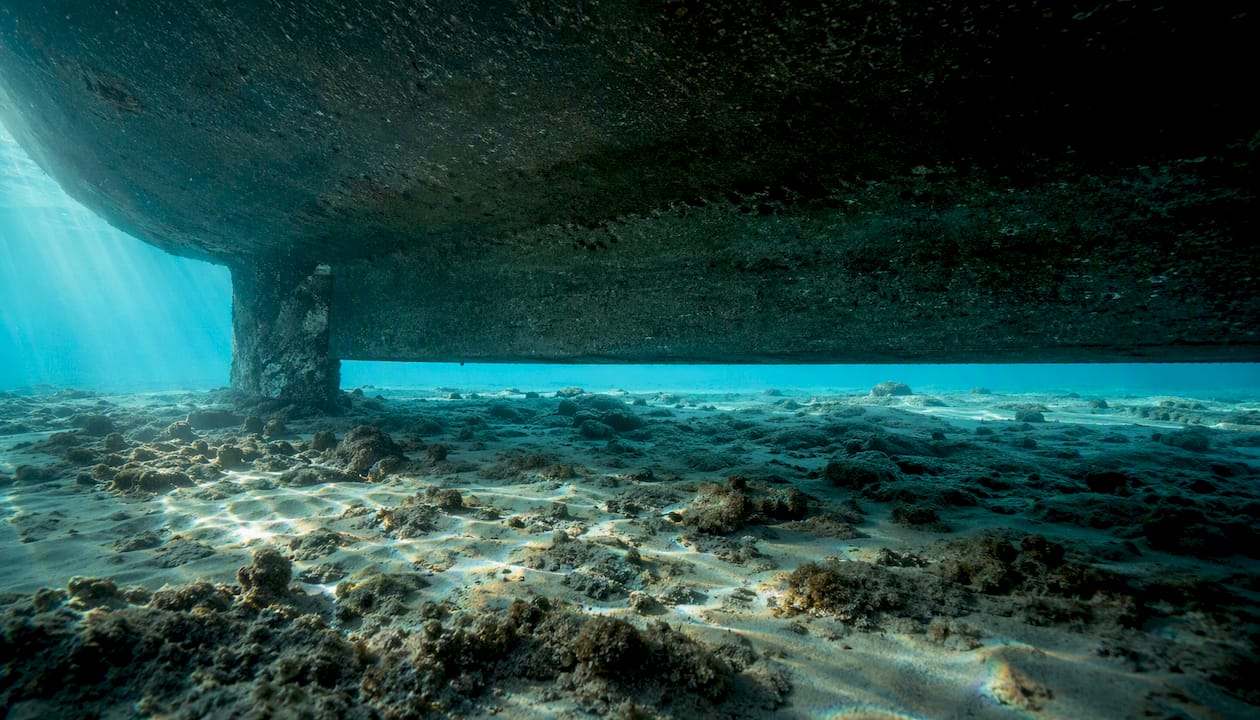
Under keel clearance (UKC) is the vertical distance between a vessel’s keel and the seabed directly beneath it. The core calculation is straightforward: UKC = Charted Depth ± Tide Height − Vessel Draft. But that static figure is only the starting point. Before you commit to a transit, you must subtract the dynamic allowances that can eat into that margin without warning:
- Squat (speed-dependent hull sinkage in shallow or confined water)
- Wave-induced motions (heave, pitch, and roll)
- Heel (static or dynamic list)
- Safety margin (a fixed reserve, typically 0.5–1.0 m depending on port rules and bottom type)
What remains after those deductions is your net UKC. PIANC/IHO guidance recommends a net UKC minimum of 0.5–1.0 m depending on risk and port requirements.
Table of Contents
- How does UKC differ from draft, depth, and air draft?
- How to calculate UKC: static first, then dynamic
- What physical factors actually reduce your available clearance?
- How to manage UKC risk on the bridge
- What role do decision-support tools and software play?
- A worked numerical example: static to dynamic UKC
- Key Takeaways
- The calculation is only as good as the judgment behind it
- Nausika brings live marine data into your UKC workflow
- Authoritative sources and further reading
How does UKC differ from draft, depth, and air draft?
These four terms get conflated on the bridge more often than they should, and the confusion costs navigators real margin.
Draft is the vertical distance from the waterline down to the lowest point of the keel. It tells you how deep the vessel sits. Keel depth is the term sometimes used interchangeably, though technically keel depth refers to the measurement of the keel structure itself rather than the vessel’s loaded immersion.
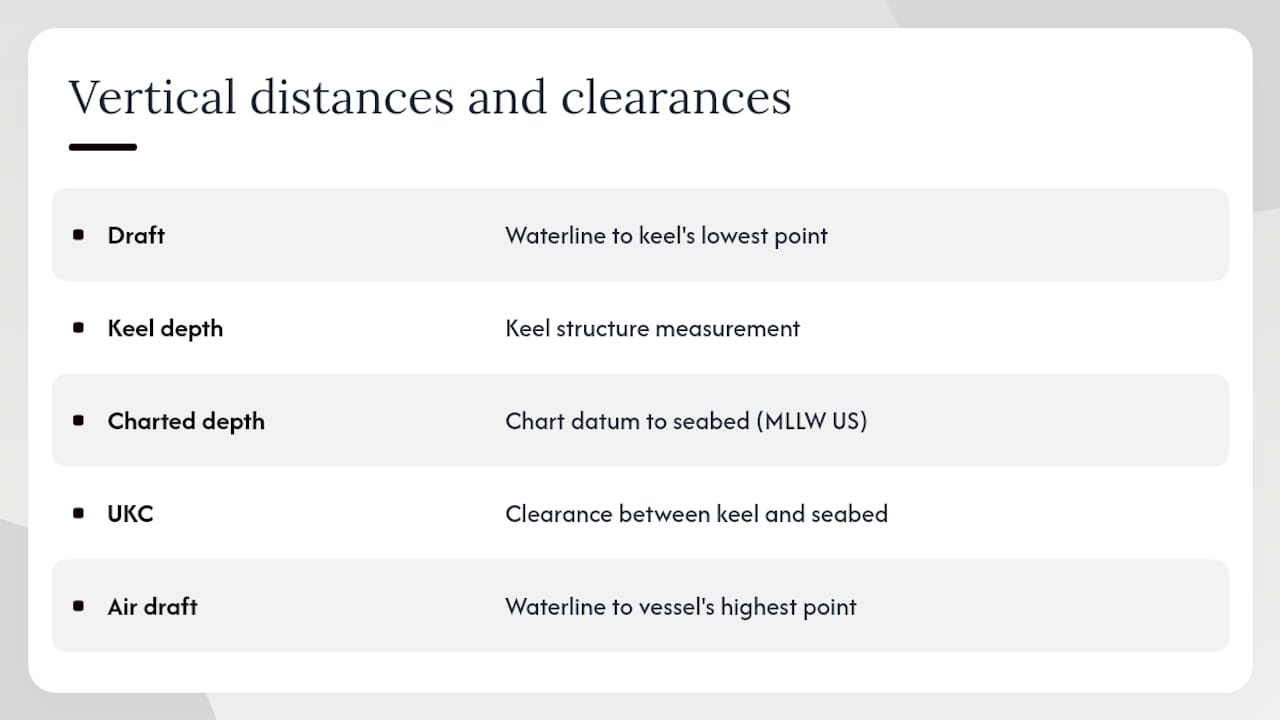
Charted depth is the depth of water shown on a nautical chart, measured from the chart datum downward to the seabed. In US waters, NOAA uses Mean Lower Low Water (MLLW) as the standard chart datum. MLLW represents the average of the lower of the two daily low tides, so charted depths are near their minimum reference level. When the tide is above MLLW, you gain water; when it falls below, you lose it.
UKC is what sits between those two: the gap from keel to seabed. It is not the same as draft, and it is not the same as water depth. It is the residual clearance after your vessel’s draft has consumed part of the available water column.
Air draft is an entirely separate concept. It measures the distance from the waterline to the vessel’s highest point, typically a mast, antenna, or stack. Air draft governs bridge and overhead clearance, not bottom clearance. Confusing the two can lead to a vessel that clears the seabed comfortably but strikes a bridge it never accounted for.
For authoritative tide and datum information in US waters, NOAA’s Tides and Currents portal is the primary source. NOAA publishes predicted tide heights referenced to MLLW for thousands of stations, and their Electronic Navigational Charts (ENCs) carry depth data on the same datum.
How to calculate UKC: static first, then dynamic
Inputs and where to find them
- ENC/ECDIS depth data: NOAA Office of Coast Survey
- Tide predictions: NOAA Tides and Currents (tidesandcurrents.noaa.gov)
- Vessel hydrostatic data: stability booklet, loading computer
- Squat estimates: vessel-specific squat tables or hydrodynamic formulas (Barras, Tuck)
- Wave and swell data: NOAA National Weather Service marine forecasts, buoy reports
- AIS position verification: onboard AIS and ECDIS overlay
The IHO’s hydrographic view on dynamic draft frames this well: gross UKC and net UKC are distinct concepts, and decision-support systems exist precisely because the gap between them is too large to manage by mental arithmetic alone.
What physical factors actually reduce your available clearance?
Squat
Squat is the hydrodynamic sinkage and trim change that occurs when a vessel moves through shallow or restricted water. It is speed-dependent and channel-geometry-dependent. In open water, squat is modest. In a dredged channel where the blockage ratio (vessel cross-section to channel cross-section) is high, squat can consume a substantial portion of your static UKC at normal maneuvering speeds. Reducing speed is the single most effective mitigation. Halving your speed does not halve your squat; the relationship is roughly quadratic, so a modest speed reduction produces a disproportionate reduction in sinkage.
Wave-induced motions
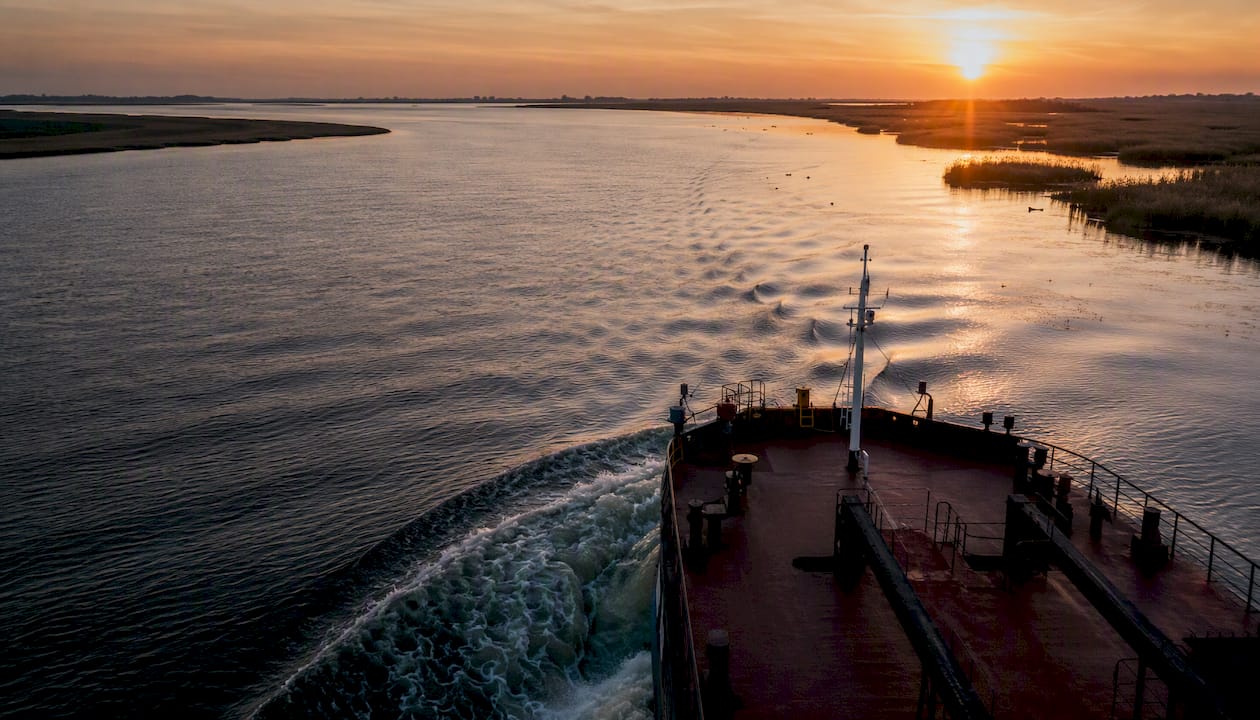
Heave, pitch, and roll each move the keel closer to the seabed at some point in the motion cycle. The critical scenario is when the vessel’s natural roll period approaches the dominant wave period, producing resonance and amplified roll angles. Long-period ocean swell is particularly dangerous because it can drive significant heave even when the sea surface looks relatively calm. A vessel that clears the bottom on average may still strike during the trough of a heave cycle.
Tide variability and seabed uncertainty
Predicted tide heights carry inherent uncertainty, especially during storm surge, strong onshore winds, or river flooding. Actual water levels can differ from predictions by meaningful amounts. Seabed surveys also age. Charted depths reflect the most recent hydrographic survey, which may be years or decades old in some US waterways. Sediment migration, shoaling, and uncharted debris can reduce actual depth below the charted value. Echo-sounder readings give you real-time depth, but the sounder reads what is directly below the transducer, not the shallowest point ahead of the vessel.
How to manage UKC risk on the bridge
Pre-transit planning
- Pull the latest NOAA ENC for the route and identify the controlling depth (shallowest charted point on track).
- Obtain the current NOAA tide prediction for the transit window and note the uncertainty band.
- Confirm the vessel’s maximum operational draft from the loading computer, including any trim correction.
- Calculate static UKC, then apply all dynamic deductions to reach net UKC.
- Compare net UKC against the port authority’s published minimum and your company’s standing orders.
- Brief the pilot on your UKC calculation before departure. Document the exchange in the bridge log.
What role do decision-support tools and software play?
Manual UKC calculation works. It also has limits. A navigator working from tide tables, a stability booklet, and a paper chart can produce a defensible static UKC. Modeling squat accurately for a specific vessel in a specific channel geometry, accounting for wave-induced motions, and updating the calculation in real time as conditions change: that is where automated decision-support earns its place.
UKC management software typically ingests:
- ENC depth data and the latest hydrographic surveys
- Real-time or predicted tide heights
- AIS position and speed over ground
- Vessel hydrostatic parameters (block coefficient, displacement, trim)
- Wave and swell forecasts
It then models squat using vessel-specific formulas, applies dynamic allowances, and outputs a net UKC figure and a recommended transit window. The IHO notes that these systems can expand operational windows by using real-time data and modeling rather than relying solely on dredging or fixed conservative minima.
A worked numerical example: static to dynamic UKC
The following example uses a hypothetical transit through a dredged US coastal channel.
Now apply the dynamic deductions:
| Deduction | Allowance |
|---|---|
| Squat (at planned transit speed) | 0.4 m |
| Wave heave allowance (moderate swell) | 0.3 m |
| Safety margin (port minimum) | a safety margin defined by port rules |
| Net UKC | 0.4 m |
That net figure of 0.4 m is below the 0.5–1.0 m minimum recommended by PIANC/IHO guidance depending on risk and port conditions, as explained in the IHO’s dynamic draft and UKC analysis. The transit as planned does not meet the minimum. The correct response is to delay until a higher tide window provides at least 0.2 m more water, or to reduce speed to cut the squat allowance.
The two inputs that move this number most are squat and tide. A 0.2 m error in squat estimation or a 0.2 m shortfall in actual tide height against prediction can push a marginal transit into a grounding scenario. That sensitivity is why documented, validated inputs matter.
Key Takeaways
A defensible UKC calculation requires validated inputs, dynamic deductions for squat, waves, and heel, and a documented master-pilot discussion before every deep-draft transit.
| Point | Details |
|---|---|
| Static UKC is the starting point | Charted depth ± tide minus vessel draft gives gross UKC; net UKC requires further deductions for squat, waves, heel, and safety margin. |
| Squat and tide are the highest-sensitivity inputs | A 0.2 m error in either can convert a marginal transit into a grounding scenario. |
| Net UKC must meet published minimums | PIANC/IHO guidance recommends a net UKC minimum of 0.5–1.0 m depending on risk, bottom type, and cargo hazard. |
| US regulations mandate documentation | 33 CFR 157.450 requires the master to calculate UKC and discuss it with the pilot; document that exchange in the bridge log. |
| Validated data changes the risk profile | Real-time tide, swell, and depth data from verified sources produce more defensible calculations than static chart data alone. |
| Nausika supplies the live data layer | Nausika connects AI assistants to validated tide predictions, swell forecasts, and harbor depth data for use in UKC workflows. |
The calculation is only as good as the judgment behind it
There is a version of UKC management that treats the calculation as a compliance exercise: fill in the boxes, get a number above the minimum, proceed. That version gets vessels into trouble.
The moments that stay with experienced navigators are the ones where the math said “go” and something else said “wait.” A tide prediction that looked fine until the wind backed offshore and held the water level 0.3 m below prediction. A squat estimate based on open-water tables applied to a channel that was narrower than the chart suggested. A swell forecast that underestimated the period, so the heave allowance was set for a 6-second sea when a 14-second swell was running.
What those situations have in common is not a failure of the formula. It’s a failure to interrogate the inputs. The master who asks “how confident am I in this tide prediction?” and “is my squat table valid for this channel geometry?” is doing something the calculation itself cannot do. Pilot communication matters here too. A pilot who has run that channel in similar conditions has information that no chart or forecast can fully encode.
Document everything. Not because the DPA is watching, but because the act of writing it down forces you to commit to a specific set of assumptions. If conditions change and you need to revise the plan, you have a baseline to revise from.
Nausika brings live marine data into your UKC workflow
One of the persistent gaps in UKC planning is the quality of the real-time data feeding the calculation. Tide predictions age the moment they’re printed. Swell forecasts shift. Harbor depth information in general-purpose AI assistants is often stale or simply fabricated.
Nausika closes that gap. It connects directly to your existing AI assistant and delivers validated tide predictions, live swell and marine forecasts, and curated harbor depth information sourced from verified marine datasets. No new app to learn. No manual data entry from a separate portal. The data arrives in your workflow, referenced to the correct datum, ready to feed your UKC calculation.
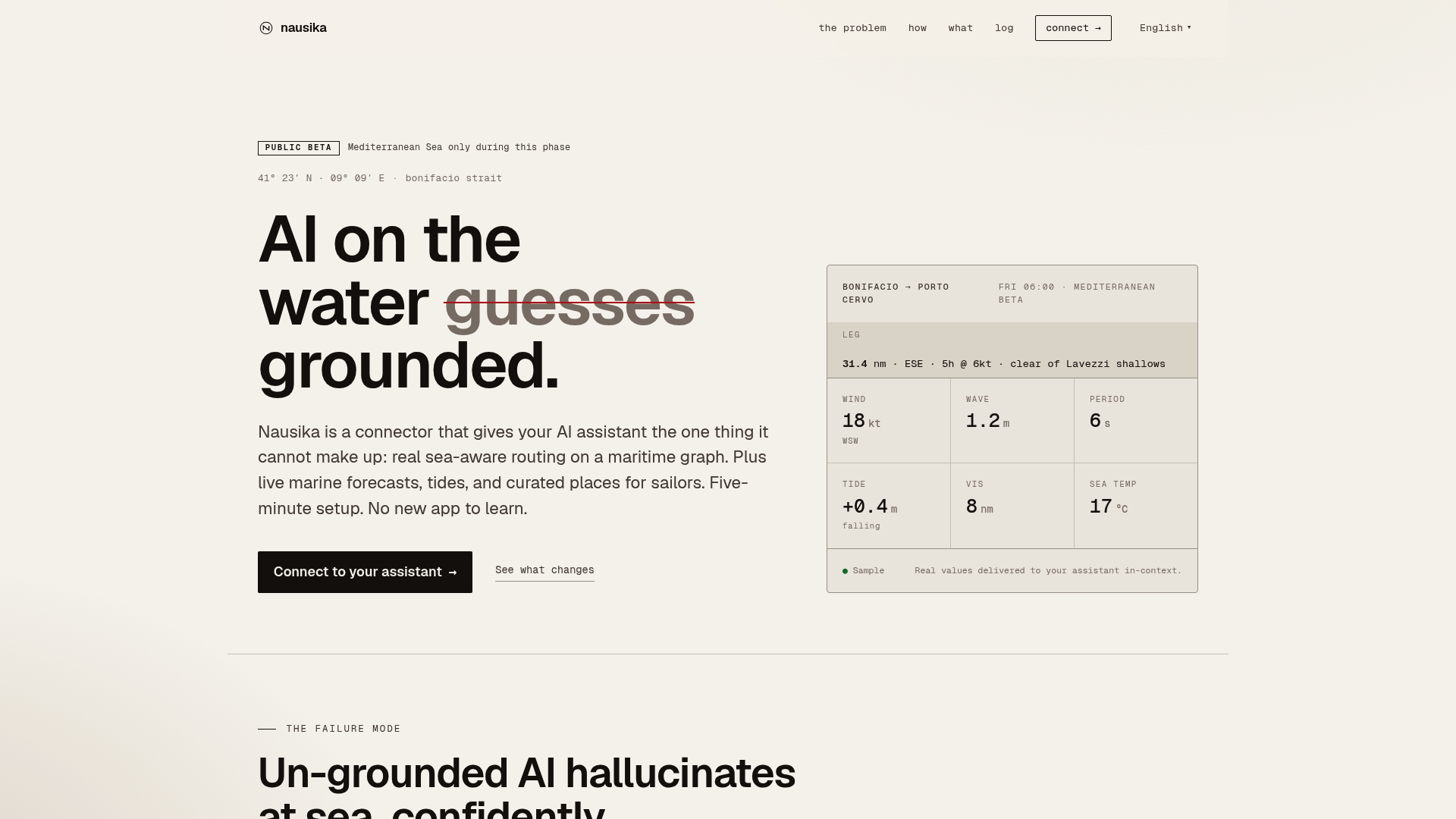
For navigators managing deep-draft transits in US waters, that means tighter, more defensible operational windows without the overhead of hunting down data from five separate sources. The master still owns the calculation and the decision. Nausika makes sure the inputs are worth trusting.
Try Nausika at nausika.app and see how validated real-time data changes what your assistant can actually tell you about the water ahead.
Authoritative sources and further reading
- All you ever wanted to know about Under Keel Clearance… but were afraid to ask
- DYNAMIC DRAFT AND UNDER KEEL CLEARANCE: A HYDROGRAPHIC VIEW — IHR
- What is Under Keel Clearance? (AMSA UKCM sheet)
- Keel depth — Wikipedia
- Air draft — Wikipedia
For port-specific UKC requirements, consult the relevant US port authority directly. Many publish channel depth tables, dredging records, and minimum UKC requirements in their port information guides or via the Army Corps of Engineers navigation data portal.