The LogProduct
Match Knots to Beaufort Force 0–12: Quick Converter for Skippers
Convert knots to Beaufort forces fast. Uses Met Office 0–12 ranges, worked examples (e.g., 25 kt → Force 6) and practical shelter and routing guidance for...

Beaufort Force 0 to 12 maps to specific knot bands, from calm (under 1 kt) to hurricane force (64 kt or more). The Met Office publishes representative mean speeds of 0, 2, 5, 9, 13, 19, 24, 30, 37, 44, 52, and 60 kt for Forces 0 through 11. To convert, multiply knots by 1.852 for km/h or by 1.151 for mph. Treat these as ranges, not fixed points: the band tells you more than any single number inside it.
TL;DR:
- Winds at 12 knots are classified as Force 4, corresponding to moderate waves around 1.0 meter, but actual sea conditions vary based on location and exposure.
- Wind speeds just below 34 knots are Force 7, with seas heaping up and foam streaks, making small craft handling significantly more challenging.
- A wind of 25 knots falls in Force 6, with large waves and spray, often prompting sailors to reconsider plans for safety and comfort.
- Converting 7 mph to knots results in approximately 6.1 knots, placing it in Force 2, which is a light breeze with minimal disturbance.
Table of Contents
- The Beaufort scale chart in knots, km/h, and mph
- Converting between knots and Beaufort force, step by step
- What each Beaufort force actually looks like at sea and on land
- Answering the most common knots-to-Beaufort questions
- Why Beaufort force is not the same as an official gale warning
- What static Beaufort tables miss when conditions shift fast
- Where Nausika fits alongside the Beaufort scale
- Sources
- FAQ
The Beaufort scale chart in knots, km/h, and mph
Each force on the scale corresponds to a knot range with a representative mean, useful for quick lookups when a forecast or a handheld anemometer gives you a raw number. The table below pulls its knot ranges and means directly from the Met Office Beaufort table, with km/h and mph calculated from the representative mean using the WMO’s conversion constants of 1.852 and 1.151.
Force 12 has no upper bound and no single representative mean. Once wind passes 64 kt, the scale stops trying to average it and simply calls it hurricane force.
One caveat matters more than the numbers themselves: the wave heights tied to each force in most charts assume open sea and fully developed conditions, meaning the wind has been blowing over open water long enough and far enough for waves to reach their expected size. Close to shore, in a bay, or after a wind shift, the sea rarely looks like the chart says it should.
Converting between knots and Beaufort force, step by step
Start with the measured or forecast wind speed in knots, then find which published range it falls inside. A reading of 25 kt sits inside the Met Office’s 22 to 27 kt band, so it is Force 6, no calculation required beyond matching the number to the range.
- Find your knot value, then locate the range that contains it: ranges, not the mean, are what actually classify the wind.
- The representative mean (like 24 kt for Force 6) is operational shorthand for briefings and charts, not a substitute for the real range when you are close to a boundary.
- To convert knots to km/h, multiply by 1.852. To convert knots to mph, multiply by 1.151.
Statistic Callout: The WMO defines a knot as exactly 1 nautical mile per hour, or 1852/3600 meters per second, the fixed constant behind every Beaufort conversion. That precision is why the same wind reads as clean round numbers in knots but messier ones in mph or km/h.
At exact boundaries, round to the nearest whole knot before assigning a force. A reading of 7 mph converts to roughly 6.1 kt, which places it inside Force 2 (4 to 6 kt) rather than the low end of Force 3.

What each Beaufort force actually looks like at sea and on land
Numbers on a chart do not tell you what to expect when you step outside, which is why the Environment and Climate Change Canada Beaufort table pairs every force with observable clues on both water and shore.
- Force 2 to 3 (4 to 10 kt): Large wavelets with scattered whitecaps at sea, wind felt on your face and light flags extended on land.
- Force 5 (17 to 21 kt): Moderate waves with many whitecaps and occasional spray, small trees in leaf begin to sway.
- Force 6 (22 to 27 kt): Large waves forming with white foam crests and some spray, umbrellas become difficult to use and large branches move.
- Force 8 (34 to 40 kt): Moderately high waves with breaking crests forming foam streaks, twigs break from trees and walking against the wind is hard.
- Force 10 (48 to 55 kt): High waves with dense foam and considerable spray reducing visibility, trees are uprooted and structural damage becomes likely on land.
These descriptions assume open water with room for waves to build. In a river mouth, a narrow channel, or under a headland’s wind shadow, the same force can look calmer or rougher than the chart suggests. When appearance and instrument disagree, trust the anemometer or a nearby buoy over your eyes.
Answering the most common knots-to-Beaufort questions
Readers usually arrive with a specific number in mind rather than the whole chart, so here is how four common figures translate.
- 12 knots falls inside Force 4 (11 to 16 kt), a moderate breeze with open-sea wave heights around 1.0 meter, per the Met Office. Whether that counts as “too windy” depends entirely on your boat, your crew’s experience, and how exposed the water is.
- 33 knots sits at the very top of Force 7 (28 to 33 kt), just below the Force 8 threshold that begins at 34 kt. Expect sea heaping up, foam blown in streaks, and a noticeably harder ride.
- 25 knots lands in Force 6 (22 to 27 kt), often called a strong breeze, where large waves and spray start to make small craft handling more demanding.
- 7 mph converts to about 6.1 kt, placing it in Force 2 (4 to 6 kt) once you round to the nearest whole knot, a light breeze with barely a ripple of real concern.
Why Beaufort force is not the same as an official gale warning
Beaufort describes what wind looks like. It does not decide when a warning gets issued, because that job belongs to national forecasting agencies with their own thresholds. The U.S. National Weather Service defines a gale warning as sustained winds or frequent gusts of 34 to 47 kt, a range that happens to overlap with Beaufort Force 8, but the warning itself is a separate regulatory product, not a Beaufort output.
Before treating any wind number as a safety verdict, check a few things the scale cannot tell you: whether the forecast speed is sustained or a gust, how long the blow is expected to last, what the wave height forecast says on top of wind speed, and whether tidal current will oppose or amplify the wind against your hull. Shelter options matter just as much as the number itself.

Pro Tip: Use Beaufort as a visual sanity check on what you see out the window, but let the official gale or storm warning, not the force number, decide whether you leave the harbor.
What static Beaufort tables miss when conditions shift fast
A Beaufort chart tells you what Force 6 usually looks like. It cannot tell you what your specific stretch of coast looks like right now, when a tide is opposing the wind or a headland is funneling gusts nobody forecast. That gap between the general chart and your particular water is where most bad calls get made. Guides like the Rule of Twelfths for estimating tidal flow, or a nearshore wave planning checklist for separating wind-driven waves from swell, exist because sailors need more than a static table to close that gap.
— Andrea
Where Nausika fits alongside the Beaufort scale
Knowing that 25 kt means Force 6 is useful. Knowing whether that wind will hold, back, or funnel through the anchorage you are aiming for is what actually decides your afternoon. A maritime assistant can pull live, validated marine forecasts, tide predictions, and harbor context from verified sources, so a Beaufort read from the deck gets checked against real data rather than a guess.
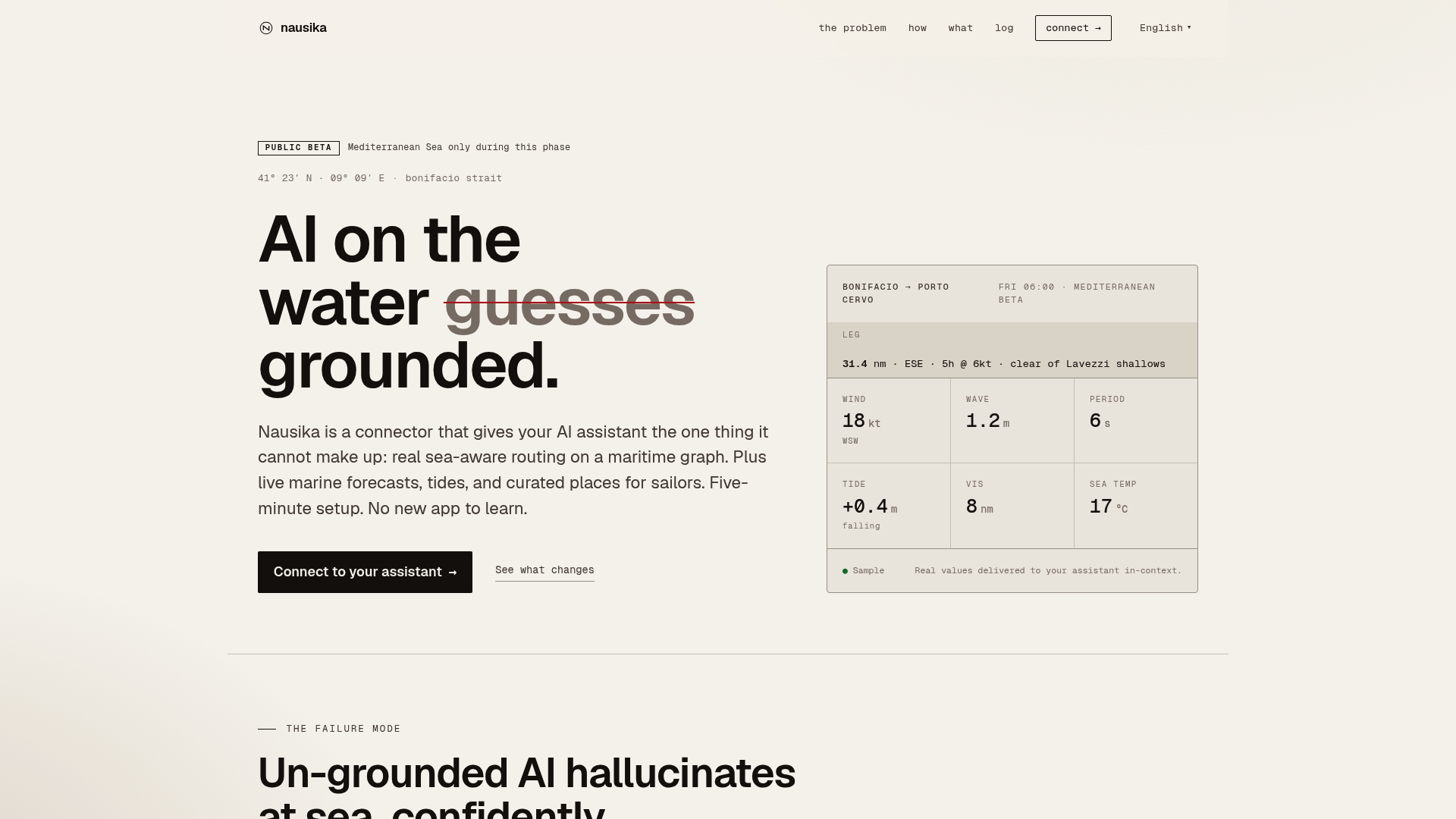
If you want that layer of live routing and shelter information sitting alongside your own eyes and a Beaufort chart, see how Nausika works and connect it to the assistant you already use.
Sources
- Beaufort wind force scale - Met Office
- Canada
- Beaufort Wind Scale - NOAA / NWS
- WMO Codes Registry — knot
FAQ
Is 12 knots too windy?
Twelve knots falls in Force 4, a moderate breeze with open-sea waves around 1.0 meter according to the Met Office scale. Whether it feels too windy depends on your vessel size, crew experience, and how exposed the water is, not on the number alone.
What is 33 knots of wind in Beaufort?
Thirty-three knots sits at the top edge of Force 7, just one knot below where Force 8 begins at 34 kt. Expect heaping seas, foam streaked across the surface, and a rougher, more demanding ride than the middle of that range would suggest.
How strong is a 25 knot wind?
Twenty-five knots is Force 6, sometimes called a strong breeze, with large waves and considerable spray starting to build. It is a level where small craft handling gets noticeably harder and many sailors start reconsidering their plans.
What is 7 mph on the Beaufort scale?
Seven miles per hour converts to roughly 6.1 knots, which places it in Force 2, a light breeze with barely a ripple of concern. That conversion depends on rounding to the nearest whole knot before matching it to a range.